Showing posts with label DSO. Show all posts

Monday, May 6, 2013

What I Don't Know About Image Processing...

... can fill a warehouse.

I revisited my earlier M42, M3 and M51 image sets to give them another go around in software.

As it turns out, there's a lot more detail in there which I simply don't know how to extract.

These images are the results of my experiments.  I included both the old and new for comparison.

M42


First pass
Second pass

M3


First pass
Second pass

M51


First pass
Second pass

For each of them, more noise is apparent.  This isn't surprising giving how the image data is being stretched.  These image sets have bias frames applied against them, but no flat frames.

In each of them, I had to brush out dust mote imprints and subtract vignetting in Photoshop as a postprocessing step.  I'd like to try minimize this by pre-processing the raw frames with flat field images. I haven't taken any of those yet.

The two biggest changes I made in processing these images was to:
  1. Not overdo the levels stretching.  Watch that histogram closely.  It's more important to get a nice bell-ish curve going (depending on the image) than to try make your background deep and your stars pop. The moment any "blackening" or "popping" occurs, you've probably lost data.
  2. Curves!!!  Holy smokes, this made a big difference!  Being able to recognize what you want to draw out, and then manipulate the curves to reflect it, has had the biggest impact.  The same rules with stretching the levels applies.  Avoid any clipping (if reasonable) so cores aren't blown out and faint stars aren't lost.


Wednesday, January 9, 2013

The Orion Nebula - Redux

If a particular DSO can be considered a cliché, M42 is probably it.... but, frankly, I wait all year for The Great Nebula in Orion to appear in my skies.    It can be seen with the naked eye, it's a staggering sight in any telescope of reasonable aperture, and it's an easy target for imaging!

It's a pity it only appears (high enough) in mid-winter.

I couldn't let this winter go by without taking a picture of it with my C6-NGT.  My last shots of Orion were with my Meade ETX 125.  While they weren't horrific, they also weren't great.

Suffice to say, my first attempt at imaging M42 with my C6-NGT went vastly better.  I wouldn't classify this image as "fabulous" (not by a long shot), but for a beginner I would certainly call it "great".

Messier 42 (NGC 1976) - The Great Nebula in Orion
There's a lot wrong with this image, from the ever-present coma, to the overexposed and blasted out trapezium and the lack of whispy volume as the nebula fans out across space.

However, I'm also getting more comfortable with my hardware and software.  Nebulosity by Stark Labs along with tutorials and guidance from sources like the Astronomy Shed on YouTube, the Astronomy Forum and Cloudy Nights has been invaluable.  I learn something new every time I take a picture.

This outing has convinced me that an autoguider would be a very useful addition to my toolkit.  So,  I've picked up the Magnificent Mini Autoguider package from Orion Telescopes and Binoculars.  The included guide scope should work well with the newt, but my mak's 1900mm focal length is likely too much.

Messier 32, not 31 (or is it the other way around?)

I have hard time remembering which is the Andromeda Galaxy and which is the smaller companion gallery.  So tonight I decided to image M32, what I thought was the big one.  Which it isn't.

Luckily, M31 is so honkin' big that it clearly fit in the frame anyway (and then some).

This image of M31/32 was created from 4 subs at 60 seconds each, with the camera's ISO set to 1600... and it's definitely not enough exposure time to bring out the whispy arms of this galaxy.  Oh, the arms of the galaxy are there.  If I dramatically overexpose/level/curve the image, the "lower" arm wrapping around the right edge of the core is easily visible.

Messier 31 and 32 (NGC 224) - Andromeda galaxy in Andromea
This image makes me want to get an autoguider even more so I can more reliably track these guys for longer periods of time.  Despite the lack of definition in this image, it's still tremendously exciting to see massive, faint, far flung objects appearing in front of your eyes.

Sunday, October 21, 2012

The Bow Tie Nebula

To finish off this weekend I tried to photograph something I hadn't looked at before.  What I learned about Caldwell 2 is that I'll probably want to barlow it when using the newt, or try capture it with my Maksutov instead.

The nebula was tiny.  Also, since the DSLR has a (relatively) large sensor compared to some dedicated entry-level CCDs, the DSO was even smaller in the result. At first, using the LCD display of the DSLR, I thought my subs weren't capturing anything but some colorful noise in the center of the images.  However, the noise was a little too consistent and large.

C2 (NGC 40) - The Bow Tie Nebula in Cepheus
One thing I've come to appreciate with the CG-5 is how consistently it pinpoints and centers the target in the eyepiece.  Chalk it up to good mechanics and/or a great alignment, but it sure helps the night go more smoothly!

I've really started noticing now how much coma is in some of these images around the edges.  Although I'm able to crop out some of the vignetting and coma, I'm beginning to understand why a field flattener or coma corrector is needed with these faster scopes.  Maybe this is also why people enjoy imaging with catadioptric scopes, too.  The higher focal length helps reduce some of the coma.

Tuesday, October 16, 2012

The C6-NGT and Astrophotography Take 2

On this night I decided to try image two targets.  One that I could clearly see with the telescope and another that I couldn't.

This round, two things were different:

  1. I spent the time ensuring I had a better alignment.  It took a great deal longer, but the results blew away my first shoddy attempts at taking pictures with this gear.  Instead of doing a simple two-star alignment with an additional calibration star, I did a two-star with several calibration stars AND I performed Celestron's All-Star Polar Alignment routine.

    Assuming the All-Star routine really works (which is evidently does), it's really amazing how far off my mount was in pointing to the north celestial pole.  I don't have a polar axis scope, and given other amateur astronomers feedback on the All-Star routine it looks like I may not really need it!

    On a good night, the alignment routine will take me 15 minutes.  This is a far cry from the 45min+ needed for a good drift alignment.  I also assume it's not as accurate as a carefully applied drift alignment.  Regardless, the All-Star routine gave me one minute exposures with virtually no trailing.  Maybe I was just lucky!
  2. I bought a bahtinov mask from Farpoint Astro.  This took all the guesswork out of focusing and as far as I'm concerned, is a cheap no-brainer accessory to add to your imaging toolkit.  I couldn't imagine focusing without it.  I first tried to make my own, but I eventually decided that $18 bought me a piece of equipment vastly superior to what I could make.

The Easy Target

M92, a globular cluster in Hercules is nice and bright in the eyepiece.  You can easily see it in a short exposure and is therefore easy to locate and center.  You don't have to spend hours imaging and processing to discover that your target is being clipped accidentally.

M92 - Globular cluster in Hercules.  4 x 30"


The alignment is definitely better, with little to no trailing.  However, evidence of coma clearly shows around the edges of the image.  Darn newt.  Well, maybe when I get better at this I can look into a coma corrector.

The Hard Target (for me)

Caldwell 34 -- the Veil Nebula in Cygnus -- is a DSO I can't see from my home with my telescopes, although I have seen it in my 10" newt at a dark(er) site.

I only took one sub of the Western Veil (30 seconds at ISO800) and at first glance I could see nothing...

C34 - Veil Nebula in Cygnus
... but it's there!  This was my first face-to-face with a DSO that would need more subs, a longer exposure and heavier processing to draw out the details.

Here's a Photoshopped version of the same image to help draw out the nebula:


Saturday, October 13, 2012

The C6-NGT's First Terrible Pictures

A couple of days after I took my brandy new C6-NGT out for first light, I decided to try hook up my DSLR to it.  The first series of pics weren't great, entirely due to a hasty and beginner's alignment.  The exposures were about 30 seconds each.

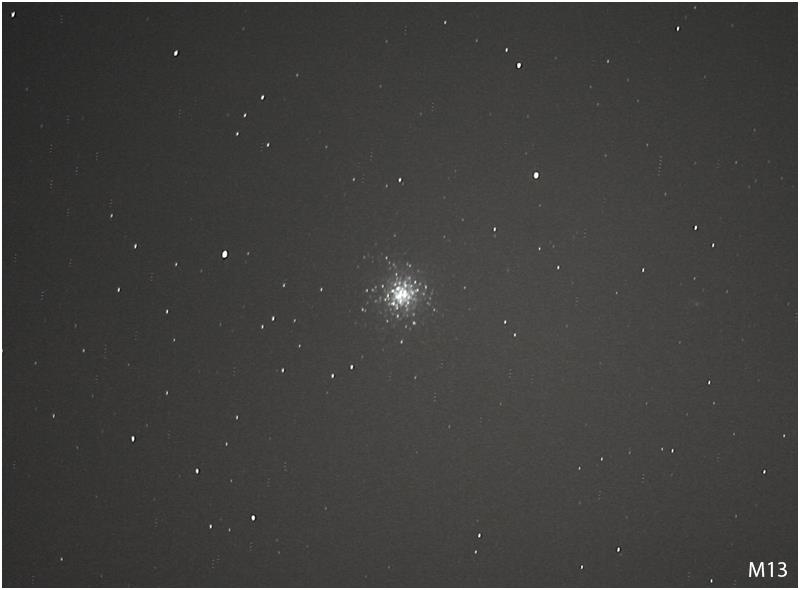
My first shot was of M13, a globular cluster in Hercules.

M13 - Globular cluster in Hercules
Compared to my first shot of M13 using the MallinCam, this image's detail is much higher, but trailing is clearly visible from a lousy equatorial alignment.  I was still quite excited about my first shot, though, on a real equatorial platform.

I then decided to slew over to M57 in Lyra.

M57 - Planetary nebula in Lyra
Just like the first shot of M13, field rotation from a bad alignment is obvious; even more so in this picture... I wonder if I bumped the mount after my first imaging of M13.  However, the color from this picture was great.

Overall, I was quite satisfied and excited about my first outing with a more capable beginners imaging set up!